UKSCA licensed education partner
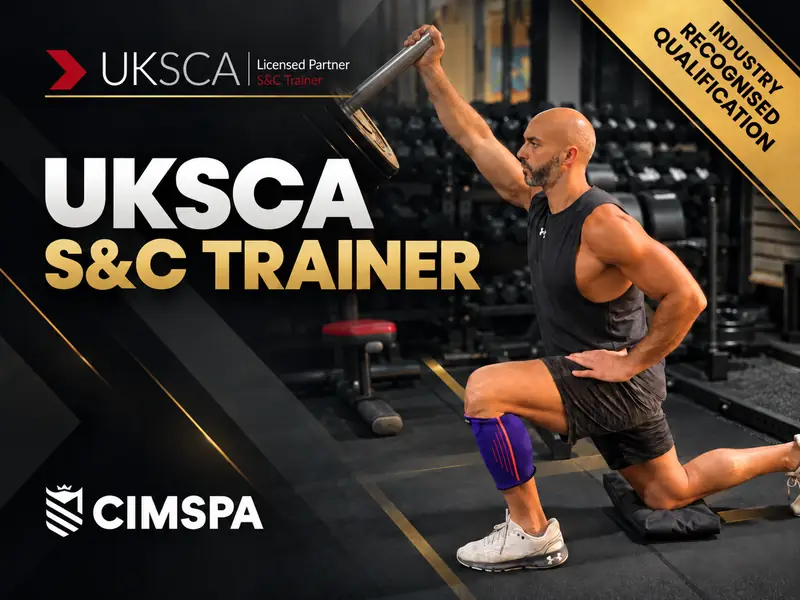
UKSCA Level 3 Strength & Conditioning Trainer
The UK's entry-level professional standard for strength and conditioning. The qualification moves beyond programme design on paper and focuses on coaching real athletes, observing against technical models and defending your decisions. Four of its five assessments put you in front of real people.
- Duration
- 6–12 months
- Delivery
- Online learning + in-person practical weekends
- Built for
- Coaches, PE teachers, trainers and physios
- November 2026 cohort
- £1,250Or 4 monthly instalments of £350 (£1,400 total).
What you will develop
Coaching that holds up when it meets real athletes.
- Coach the foundation movement patterns — squat, hinge, lunge, push, pull, rotation, running, jumping and landing.
- Observe against a technical model, read the fault that matters and cue the correction.
- Progress and regress any exercise to fit the person in front of you.
- Develop strength, hypertrophy, muscular endurance and rate of force development.
- Train the aerobic and anaerobic energy systems with intent.
- Coach acceleration, deceleration and change of direction.
- Run a strength session safely — set-up, spotting and failing safely.
- Assess a real athlete and build a twelve-week programme from it.
Meet your tutor

Hani Assi
MSc, ASCC · Founder & Course Lead
- MSc Strength & Conditioning
- University of East London
- UKSCA Accredited Coach
- Accredited Strength & Conditioning Coach (ASCC)
- UKSCA Licensed Partner
- Level 3 S&C Trainer delivery
Hani is the founder of Assi X Performance and AXP Academy, with more than 15 years of experience across strength and conditioning, coach education and elite sport in the UK, Saudi Arabia and internationally. He holds an MSc in Strength & Conditioning from the University of East London, where he studied as a Chevening Scholar.
His experience includes the Saudi Olympic Training Centre, Saudi national teams, Great Britain and England youth basketball, and Leyton Orient FC. He supported Saudi basketball at the Hangzhou Asian Games and para-athlete preparation for Paris 2024, alongside work across rugby league and women’s basketball. His work also includes supporting elite and professional combat sports athletes, including professional boxer Hamza Sheeraz.
A former guest lecturer and lead S&C coach at the University of East London, Hani brings an educator’s eye to practical coaching. His teaching connects the evidence to the decisions you make with athletes: what to assess, how to programme, how to coach and when to progress.
Course pathway
How the learning progresses
- 01Role & science
Understand the job
Scope of practice, when to refer on, and the science underneath training.
- 02Foundations
Coach the patterns
Technical models, reading faults, cueing, progressing and regressing.
- 03Under load
Coach strength safely
Strength training, spotting and safety, session design and prescription.
- 04Applied
Plan, deliver and defend
Needs analysis, a twelve-week programme, its delivery and your reflection on it.
Core text: Foundations of Strength and Conditioning (UKSCA, 2022).
The UKSCA standard
Coached, not just written.
The UKSCA built this level because too many S&C qualifications produce practitioners who can design a programme and have never delivered one. The standard is weighted towards applied coaching hours with real people, in real training environments.
It also widens the scope deliberately. Foundation movement skills and energy systems come before heavy lifting and complex exercise, which is what makes the standard usable with youth, recreational and general populations rather than elite squads alone.
Anyone can write a programme. Far fewer can coach one.
What is included
Built for applied practice.
- In-person practical weekends, where assessments A, B and C are completed.
- Online learning modules and individual sessions with your tutor.
- UKSCA associate membership and UKSCA-IQ access.
- A copy of the core text.
- Awarding-body registration with Transcend Awards.
- Assessor support through the twelve-week programme.
Who it is for
Built for people who already work with athletes.
The qualification assumes contact with people who train. Four of the five assessments require it, and one requires a participant you can work with consistently for twelve weeks.
- Sports coaches programming conditioning alongside technical work.
- PE teachers developing athleticism in school-age athletes.
- Personal trainers moving from general fitness into performance.
- Physiotherapists who want to own the training side of return to sport.
- Early-career S&C coaches who need assessed coaching hours.
- Military, emergency-service and academy staff preparing a group.
Before you start
What you need in place.
No degree and no Level 2 qualification required. Entry is discussed individually at application.
- A participant you can coach consistently for twelve weeks.
- Access to a gym with enough equipment for loaded strength work.
- 380 hours total qualification time, 60 of them guided.
- Aged 18 or over, with some involvement in sport or exercise.
Tell us at application about any learning need or injury affecting practical participation. Adjustments are routine.
Qualified to accredited
The Trainer standard is a beginning, not a ceiling.
You finish licensed to practise as a UKSCA S&C Trainer and listed on the UKSCA register — coaching youth, adult and recreational athletes independently, or supporting performance athletes within a team under an Accredited S&C Coach.
The elite end sits at Accredited S&C Coach (ASCC). The Diploma counts toward UKSCA and CIMSPA membership and is the recognised entry onto the ASCC pathway.
Insurance. Through a governing body, school or employer, this should let you deliver S&C under their existing cover. Private work needs your own policy.
Delivery
In person where it counts.
- In-person practical weekends for coaching, feedback and assessment.
- Online modules, tutor-directed study and individual development sessions.
- A twelve-week applied programme with your own participant.
- Limited cohort size, to keep coaching feedback individual.
The outcome
Assessment is part of the learning.
You build evidence across the course rather than facing one hurdle at the end. Three practical assessments in person with your cohort, then two that follow a twelve-week programme you deliver to a real participant.
Foundation movements
Coach a 20-minute session to a small group.
Safety in the gym
Set-up, spotting and failing safely.
Strength-based training
Coach a 40-minute session to an individual.
Programming and planning
Needs analysis, testing and a twelve-week programme, presented one-to-one.
Impact and reflection
Programme outcomes, a reflective log, and an anatomy and physiology quiz.
Choose your twelve-week participant before you enrol. An athlete you coach is ideal; a training partner, friend or family member playing sport also works.
Questions
Straight answers.
Do I need a degree?
No. Plenty of learners arrive from coaching, teaching and the gym floor.
Is this the same as UKSCA accreditation?
No. Accredited S&C Coach (ASCC) is the advanced level. This is the entry level — a step onto that pathway, not a shortcut through it.
Do I have to be strong myself?
No. You are assessed on your coaching, not your lifting — though you need to demonstrate movements well enough to teach them.
Can I do it entirely online?
No. Assessments A, B and C are in person. Everything else is online.
Who can be my twelve-week participant?
Anyone real playing sport at any level, who is not on your course.
How long does it really take?
Plan for 6–12 months. The twelve-week programme sets the timeline, not the taught days.
Take the next step
Request your place on this course.
AXP Academy delivers this qualification as a UKSCA licensed education partner. Complete the course and all five assessments with us.
November 2026 cohort
Start date to be confirmed
Paid in full
£1,250
Instalments
4 × £350 (£1,400 total)
Exact practical dates will be confirmed before enrolment is finalised.